
Foto de Esteban Tisnés

Esteban Tisnés

Economics Researcher, Banco Central del Uruguay


Welcome! I am an Economics Researcher at Banco Central del Uruguay. My research interests are in the fields of International Macroeconomics, Monetary and Fiscal Policy.

Curriculum vitae

Working papers

What Drives the Cross-Country Differences in Hand-to-Mouth Shares?

with Clara Arroyo (IMF)

July 2025
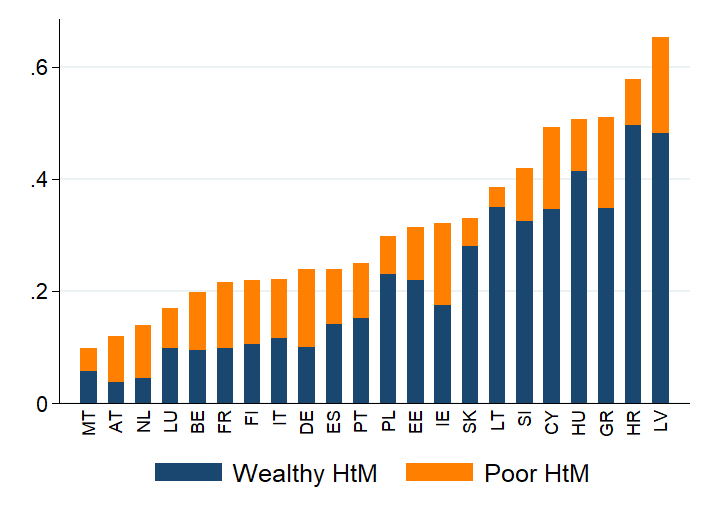
Recent literature has highlighted that differences across countries in the share of Hand-to-Mouth households (HtM) are important for the transmission of aggregate shocks as well as monetary and fiscal policy. How can we explain cross-country differences in the share of hand-to-mouth households? In this paper, we first document significant heterogeneity in the share of HtM households across European countries. This heterogeneity is driven by large differences in the share of wealthy HtM households, who hold illiquid but no liquid wealth. On the contrary, the share of poor HtM, who hold neither liquid or illiquid wealth, is similar across countries. Second, we develop a two-asset life-cycle model with incomplete markets and uninsurable income risk and calibrate it to Spain. Through the lens of the model we study the role country differences in income risk, the life-cycle profile of earnings and retirement benefits. Although we report substantial differences across countries in mean income, risk and retirement benefits, results suggest that they cannot explain cross-country differences in the share of HtM by themselves. On the other hand, differences in financial conditions are able to explain, ceteris-paribus, 51% of the differences in HtM shares, by explaining 68% of W-HtM shares.
  • BCU Annual Conference 2024, LACEA LAMES 2024
Macroprudential Use of Foreign Reserves Accumulation

June 2024
Emerging market economies often face volatile capital inflows, leading to sudden stops and capital flight that provoke macroeconomic adjustments. Theliteratureon macroprudential policy in this context has focused on the use of capital inflows taxes. However, the accumulation of foreign reserves are the most widely used prudential tool. This paper introduces market segmentation in international financial intermediation into a standard macroeconomic model of financial crises to examine its impact on optimal policy. The model features a small open economy with incomplete markets and an occasionally binding collateral constraint. The central bank uses FXI to create a wedge between domestic and international interest rates, leading to increased net foreign assets but also carry trade losses. The findings indicate that optimal foreign reserves accumulation policy leans against the wind but less aggressively than in the absence of market imperfections, due to the increasing costs of accumulating reserves.

Asymmetric sectoral responses to weather shocks: An Application to Uruguay

with Juan Pablo Medina (UAI)

February 2026
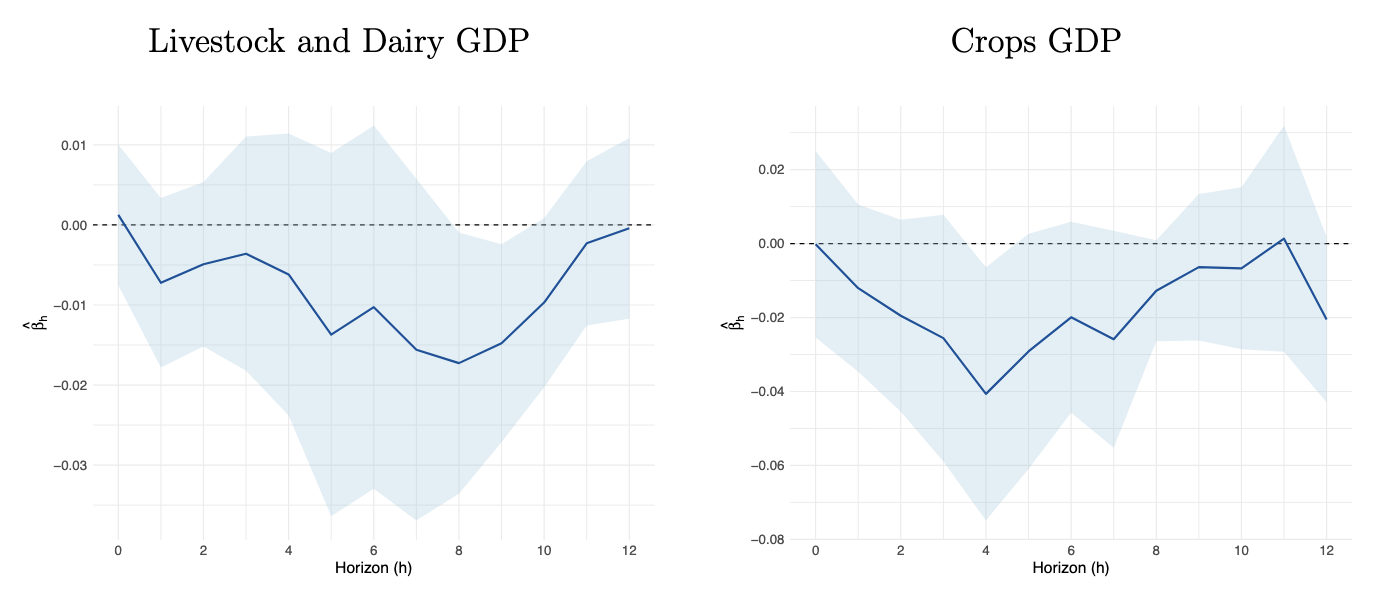
Climate change has increased the frequency and intensity of droughts in several countries, with significant macroeconomic consequences particularly in the agricultural sector. Uruguay is one such country that has recently faced adverse weather conditions affecting its productive capacity. This work aims to complement previous studies on the topic in three main areas. First, we document asymmetries in the empirical responses of agricultural sub-sectors to weather shocks. Second, we extend a structural model to account for differences in the transmission of weather shocks across sectors. Third, instead of estimating the model using Bayesian methods, we select key parameters to replicate the impulse response functions obtained from our empirical estimations. Our results highlight important asymmetries and non-monotonic responses in the productive capacity of crops and livestock-dairy sectors following weather shocks in Uruguay.

Work in progress

Fiscal Surprises and Inflation Expectations

with Javier García-Cicco (U. de San Andrés), Miguel Mello (BCU) and Jorge Ponce (BCU)

Work in progress
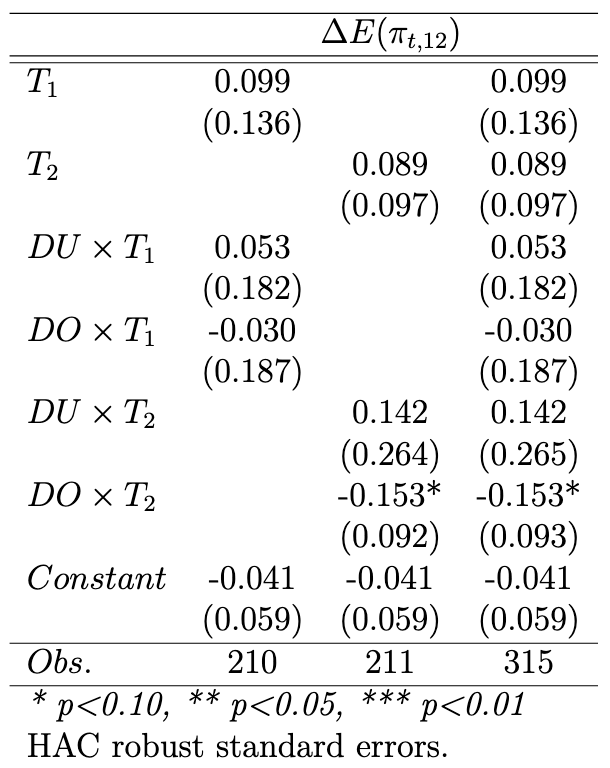
We causally identify how firms' surprises about the fiscal situation affect their inflation expectations and credibility in the central bank. While no treatment shifts the average one-year-ahead inflation expectation, they produced sizable, systematic and heterogeneous movements in the distribution. Firms that had underestimated the debt-to-GDP ratio revised inflation expectations upward, whereas over-estimators revised them downward, so that the mean effect netted to zero. Beyond point expectations, treated firms reallocated subjective probability mass across scenarios to finance the fiscal deficit: the likelihood they assigned to orthodox deficit reduction rise and the likelihood of inflationary financing fall among initially pessimistic firms. These findings highlight how simple debt disclosures can reshape tail risks and policy beliefs even when short-run average inflation expectations do not move.

Universidad ORT Uruguay

Undergraduate

  • Time Series Econometrics (2024, 2025)
  • Principles of Statistics (2025)

Graduate

  • Time Series Forecasting (2025)

CEMFI

Master of Economics and Finance

  • Topics in International Macroeconomics (2022, 2024): TA of Sebastián Fanelli
  • Macroeconomics II (2023): TA of Nezih Guner

40 JAE app

Aplicación para analizar de forma interactiva los trabajos presentados en las 40 ediciones de las Jornadas Anuales de Economía del BCU.

40 JAE app

Abrir app

ARIMA Simulation Lab

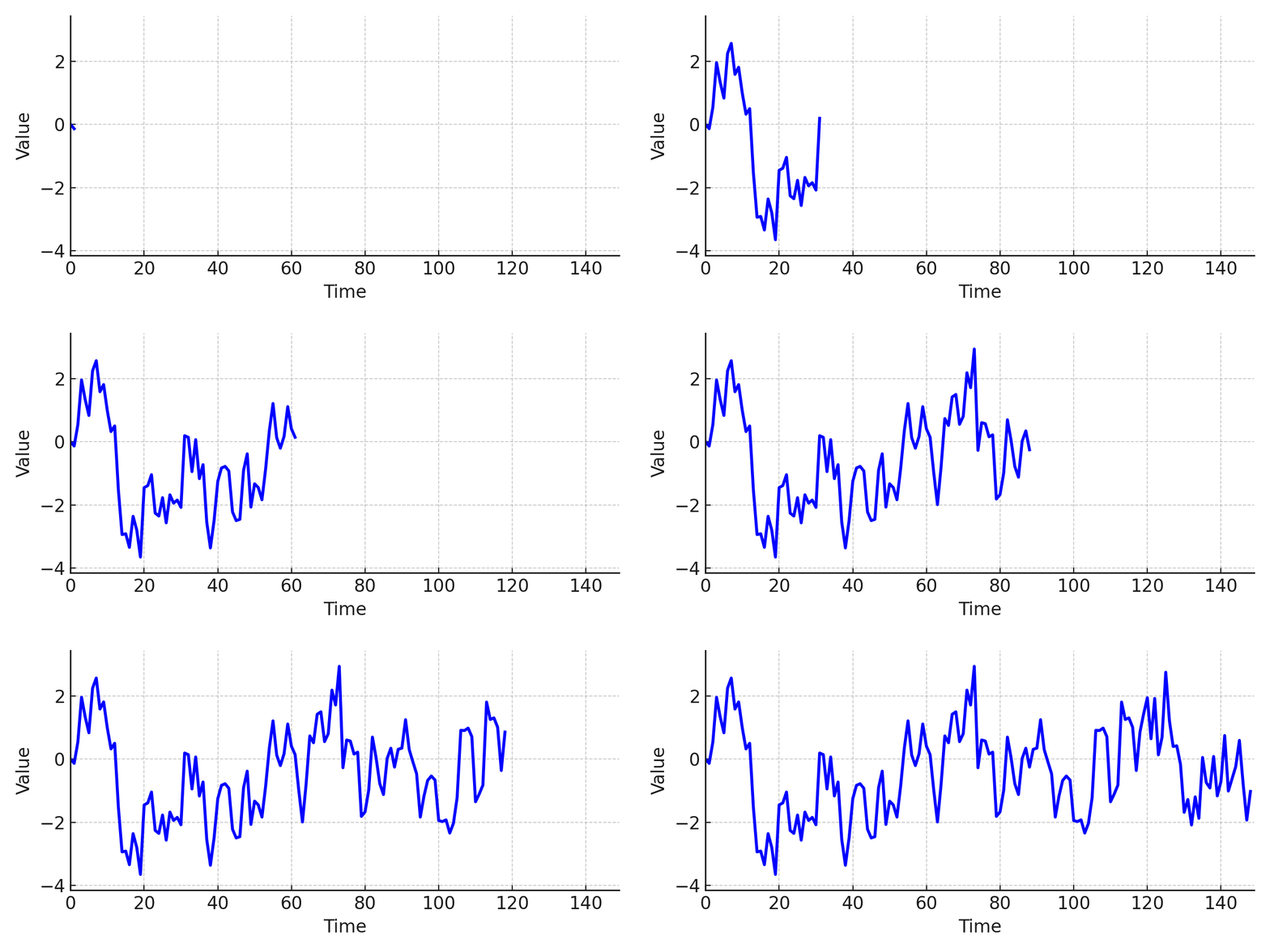
Aplicación para apoyar la enseñanza de Econometría de Series de Tiempo mediante la familiarización con las características que presentan series de tiempo simuladas.

ARIMA Simulation LAB

Abrir app